Every few months, outbound gets declared dead.
Right now, the headline is AI.
Tools can research accounts in seconds, generate sequences instantly, and fire off thousands of emails without a single rep involved. On paper, it looks like the BDR role should be next on the chopping block. We’ve all heard it “the rise of the AI-SDR” 🤮
In practice, teams that rush to replace people with automation often end up with more activity, less pipeline, and harder-to-diagnose problems.
The real question is not whether AI can replace BDRs.
It is which parts of outbound never should have been human work in the first place, and which parts still need a person to own the consequences.
This week, we will break down what AI can realistically automate in outbound sales, what still requires human judgment, and how to modernize the BDR role without inadvertently degrading pipeline quality.
Estimated reading time is 3.5 minutes. Hit reply and tell us what you are seeing on your side.
On Deck:
AI in outbound: What it replaces, what it breaks, and what still needs humans
Marketing tip of the week, powered by Decoded Strategies
Episode #132 Why Strategy Fails Without Execution (And How RevOps Holds It Together) | Nicole Brownell
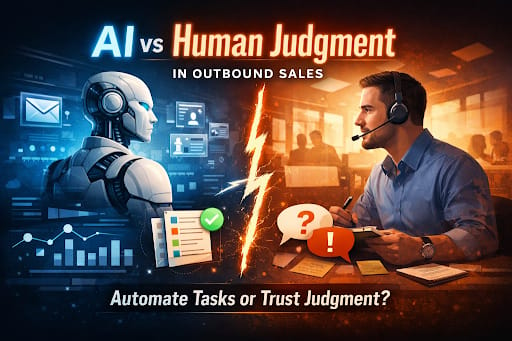
What AI Actually Replaces in Outbound Today
List building and account enrichment
AI reliably handles prospect list creation, data enrichment, and basic firmographic validation. Pulling titles, industries, funding status, and tech stack data no longer needs human effort. This work is necessary but low-leverage. Automating it removes hours of prep and frees reps to spend time on revenue-generating activities such as conversations, not spreadsheets.Baseline account and contact research
AI can summarize company descriptions, recent news, job postings, and public signals faster than any human. This replaces tab-hopping and note-taking. What it does not replace is deciding which details actually matter to the buyer or how those details should shape a specific outreach strategy.First-draft outbound messaging
Sequence drafts, email structure, and initial copy are well-suited to AI when prompts are constrained. AI removes the blank-page problem and accelerates setup. Drafts still need review for relevance, timing, and intent - EVERY SINGLE TIME. Treat AI output as an input to evaluate, not an output to ship.Lightweight personalization at scale
AI is effective at inserting role-level and industry context across large volumes, reducing copy-and-paste work and basic errors. When personalization falls short, it undermines credibility more quickly than no personalization at all. Humans must decide when personalization is meaningful enough to earn attention and when it should be skipped.Task prioritization and workflow setup
AI can rank accounts, suggest follow-ups, and flag stalled prospects using rules and historical patterns. This replaces manual workflow management. When rankings repeatedly surface low-quality opportunities or misprioritize accounts, humans should override and adjust the rules. Prioritization helps guide decisions but doesn’t control them.
Where AI Falls Short, Even With Perfect Data
Interpreting intent, not words
AI struggles when replies are ambiguous. A short “maybe,” delayed response, or non-answer often carries more signal than text alone. Humans read intent through timing, history, and context. Even with clean data, AI cannot reliably infer what a buyer actually means, and misreads often lead to stalled follow-ups or missed meetings.Handling objections in motion
Objections usually surface gradually, not all at once. They evolve as new concerns surface. Deciding when to push, pause, or disengage requires judgment shaped by experience and coaching. Automating these moments does not remove risk. It shifts it downstream, where objections resurface later and cost more to recover.Adapting to unexpected turns
Real outbound conversations constantly break the pattern. New stakeholders appear, priorities change, and internal politics surface mid-thread. AI performs best in predictable paths. When the conversation veers, humans must recalibrate in real time or momentum dies quietly without an obvious error to fix.Owning the consequence of a response
AI can generate confident language, but it cannot own the fallout when that confidence is misplaced. When a reply overcommits or misjudges tone, AEs and managers absorb the cleanup later. Accountability never belongs to the tool, even when the tool is speaking.
Why Replacing BDRs Looks Easier than It Is
Outbound looks simple until you run it
BDR work appears transactional from the outside. Send emails. Book meetings. Move on. In practice, most replies live in the gray. Timing is off, interest is partial, and internal politics are unclear. Reading that signal is a learned skill, not instinct, and it is where most outbound effort actually goes.Early signals disappear when humans are removed
When AI replaces the role instead of supporting it, subtle buyer signals get lost. Hesitation, soft interest, and early objections are misread or ignored. Those signals do not disappear. They resurface later as low-quality meetings, requalification work for AEs, and stalled deals that looked healthy at the top of the funnel.Dashboards improve while the pipeline weakens
Automated outbound often inflates surface metrics such as sends, replies, and meetings booked. The cost shows up downstream. Conversion drops, cycles lengthen, and forecast confidence erodes. The outbound dashboard looks strong while revenue teams absorb the fallout later in the deal cycle.
What Breaks When Outbound Goes Fully Automated
Fully automated outbound optimizes for volume instead of learning. Sequences keep running even after messaging stops resonating. The same objections appear across replies with no adjustment. Negative feedback gets logged, ignored, or buried while activity metrics continue to look healthy. Automation keeps pushing long after the market has shifted.
Human BDRs are not just execution engines. They are sensors. They hear why buyers hesitate, when competitors are winning, and where positioning falls flat. When that layer disappears, learning slows even as volume spikes. Conversion drops later, cycles stretch, and teams realize too late that pipeline quality has been quietly eroding.
That is why fully automated outbound feels efficient early and expensive later. Without humans in the loop, no one owns learning, and the cost shows up downstream. This is exactly the gap a deliberate reset is designed to close.
A 30-Day Plan to Modernize the BDR Role with AI
Week one: Strip out low-value human work
Audit how BDRs actually spend their time and assign a single owner to make the call on what moves to AI. Low value means low decision impact, not low effort. List building, enrichment, baseline research, and first-draft writing belong with AI. Free up human capacity before touching headcount.
Week two: Redesign ownership, not volume
Define which moments must stay human, including reply interpretation, objection handling, prioritization, and meeting qualification. Make humans explicitly accountable for decisions, not just responses. AI can assist, but it should never own judgment in moments that affect pipeline quality or downstream trust.
Week three: Train judgment, not scripts
Coach BDRs on reading intent, spotting hesitation, and knowing when to advance, pause, or disengage. Use real replies and live threads as training material. AI suggestions should be treated as inputs to evaluate, not instructions to follow. Judgment improves when it is coached, inspected, and reinforced.
Week four: Inspect pipeline quality with triggers
Review meetings booked, conversion to next stage, requalification rates, and AE feedback. Define clear thresholds that force change, such as declining meeting-to-opportunity conversion or repeated rework by AEs. Adjust the AI-human split when these signals appear, not after pipeline misses show up.
The Bottom Line
AI is not ending outbound. It is forcing teams to confront how fragile the early pipeline really is.
The question is not whether AI can send messages or book meetings.
It is whether your outbound motion still captures intent, hesitation, and timing before deals enter the pipeline.
Teams that use AI to strip out busywork and protect human judgment create a cleaner pipeline with fewer surprises. Teams that use AI to replace judgment trade short-term efficiency for long-term conversion problems.
Outbound does not fail loudly. It fails later.
Shoutout to Sendoso for Keeping This Newsletter Free!

We trust Sendoso for all our gifting needs. Why?
Thoughtful gifting fosters meaningful connections.
The best product catalog in the space & truly personalized gifting.
AI-powered personalized triggers enhance engagement throughout the sales process.
We’ve seen firsthand how effective gifting accelerates pipeline and retention. If you’re looking to win and retain more customers, book a demo with Sendoso, and we’ll personally send you a special gift, just reply and let us know you booked!
Check Them Out.
Marketing Tip of the Week - Powered by Decoded Strategies
Ask Customers What Almost Stopped Them
During post-sale interviews, skip 'Why did you buy?' and ask 'What almost stopped you?' Those objections are pure gold for marketing copy. Use them in your ads and landing pages to show you understand real hesitation.
Episode #132 Why Strategy Fails Without Execution (And How RevOps Holds It Together) | Nicole Brownell
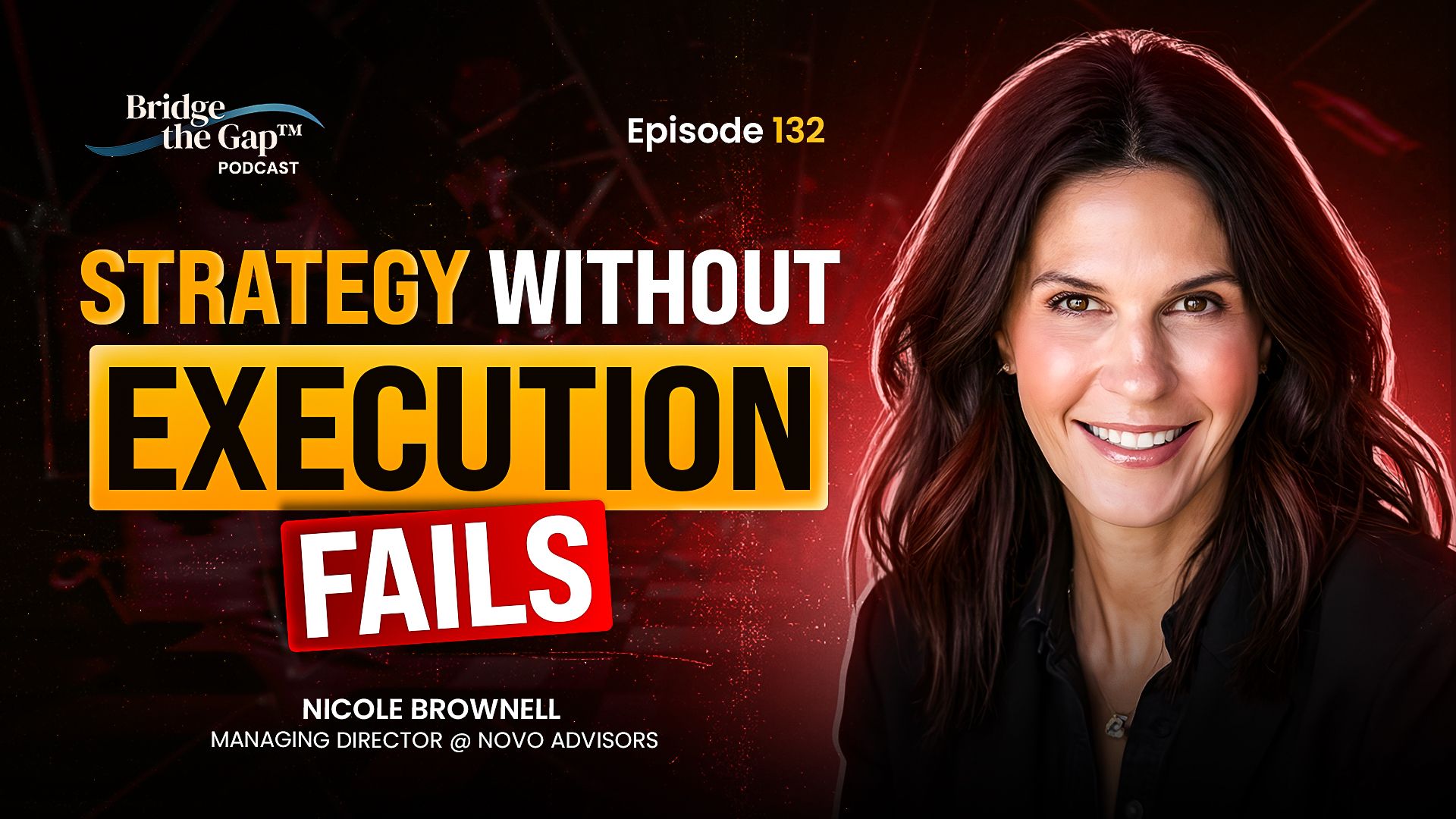
Everyone talks about strategy. Very few teams can execute it.
In this episode of Bridge the Gap, we sit down with Nicole Brownell, Managing Director of Growth and Value Creation at Novo Advisors, to unpack why most go-to-market strategies stall and what it actually takes to build execution that scales.
Nicole shares hard-earned lessons from turnarounds, PE-backed environments, and complex GTM organizations, breaking down where alignment really fails, why RevOps is a system (not a role), and how leaders must bridge strategy, operations, and accountability.
We cover why early growth often hides deeper issues, how misaligned KPIs create downstream friction, and why outcomes, not decks, are redefining modern consulting and operating models.
Key highlights:
✓ Why most companies do not have a growth problem
✓ How RevOps connects strategy, systems, finance, and execution
✓ The real difference between alignment and shared accountability
✓ Why strategy decks fail without embedded execution
✓ What PE-backed companies demand from GTM and operational leaders
✓ How founders mistake early traction for long-term enterprise value
If you are a founder, operator, or GTM leader trying to turn strategy into sustained execution, this episode is for you.
Agree? Disagree? Have Questions?
Experimenting with AI in outbound and unsure where it helps or hurts? Reply, and we will work through it with you.
Talk soon,
Adam, Dale, & Jake
Helping companies bridge the GTM Gap™.