Spam filters used to be the biggest risk in client communication. Now it is confidence without accountability.
Real-time AI bots are stepping into live client conversations. They answer questions in chat, draft replies during calls, and sometimes speak directly to clients with no human in the loop. When it works, response times drop and coverage improves. When it fails, reps end up explaining or undoing automated answers while clients quietly (or very loudly) lose confidence.
The issue is not the model or the platform. It is a boundary problem. Teams move bots into moments that feel efficient internally but require ownership externally. Dashboards look better. Trust gets thinner.
This week, we will break down where AI bots improve client communication, where they fall apart, and how to introduce them without breaking client relationships.
Estimated reading time is 3.5 minutes. Hit reply and tell us what you are seeing on your side.
On Deck:
Real-time AI bots in client conversations: Where they help and where they hurt
Marketing tip of the week, powered by Decoded Strategies
Ex-SpaceX Exec Reveals the Secret to Scaling Without Breaking Everything ft. Michael Guymon
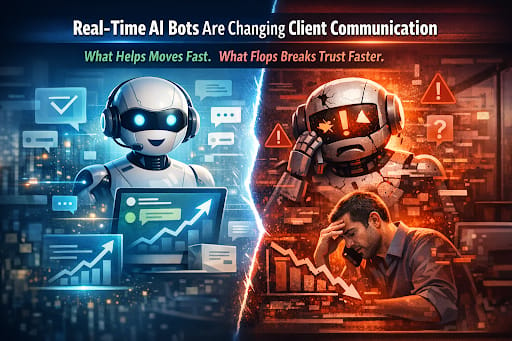
Why Real-Time Bots Feel Inevitable Right Now
Client communication has hit a breaking point. Volume keeps rising, expectations keep tightening, and teams are being asked to do more with less. Real-time AI bots feel inevitable because they promise relief from that pressure, even when the trade-offs are not fully understood.
Client expectations have reset
Buyers now expect near-instant responses because that is the experience they get in consumer tools and modern software. That expectation has carried into B2B. Waiting hours for a simple answer feels outdated, even when the question is low risk. Teams feel constant pressure to match that pace across every client interaction, whether the moment actually requires speed or judgment.Too many channels, not enough focus
Client conversations now happen across live chat, in-app messaging, email, and other digital touchpoints. Each channel adds context switching and mental load for reps. Bots look appealing because they promise to absorb routine questions and reduce fragmentation. The risk is that automation starts filling gaps before teams decide which conversations should stay human.Headcount cannot keep up with demand
Many teams are handling more accounts, more complexity, and longer client lifecycles without proportional headcount growth. Hiring lags demand. Real-time bots appear to offer scale without payroll impact, especially for after-hours coverage, peak volume, and repetitive requests that drain experienced reps. Scale becomes the goal before boundaries are defined.Leadership wants consistency at scale
Response quality often varies by rep, region, or shift. That inconsistency shows up in client feedback and renewals. Bots promise standardized answers, tone, and coverage, which feels safer to leadership than relying on individual judgment. The risk is that consistency replaces nuance, and automation gets deployed in moments where accountability still matters, simply because it reduces variance on paper.Speed is easier to measure than trust
First response time and resolution speed are visible, reportable metrics. Trust, confidence, and relationship strength are harder to quantify. As a result, teams optimize for speed because it shows up on dashboards, even when faster replies push automation into moments that require judgment, ownership, and human context.
The Conversations Bots Handle Better than Humans
Fast, factual client requests
Status checks, scheduling changes, documentation access, onboarding steps, and basic configuration questions all benefit from immediate, consistent responses. In these moments, clients want clarity and closure, not discussion. Automation works here because accuracy and speed matter more than judgment or persuasion.Repetitive work that drains experienced reps
Routine questions pull senior reps into low-impact work. Offloading those interactions frees humans to focus on complex issues, renewal conversations, and proactive account work that actually affects retention and expansion.Support during live, human-led conversations
During calls or live chats, AI can surface account history, draft responses, and suggest next steps in real time. When the client never interacts with the automation directly, the conversation stays human while the quality improves behind the scenes.
The Moments Where Bots Quietly Break Trust
High-stakes decisions
You must apply judgment and take ownership of pricing explanations, contract changes, escalations, and risk-related questions. When automation speaks with authority in these moments, small gaps or assumptions can quickly undermine confidence.Nuance and context shifts
Real conversations change as new information surfaces. Bots cannot adjust intent or tone when stakes shift, even if the answer sounds correct on the surface.Conflicting answers across touchpoints
When a bot gives one response and a human gives another, trust drops fast. Even quick corrections leave clients questioning which answer to believe.Automation speaking out of turn
Clients do not blame the tool. They blame the company for allowing automation to handle moments that should have stayed human.
What Clients Do When the Bot Crosses the Line
You can see this before it hits surveys or churn reports. Clients ask for a human earlier in the conversation. Issues bounce between the bot and the rep instead of resolving. Reps spend time undoing or clarifying automated responses. Resolution slows even though the first response time looks better.
These behaviors signal a boundary problem, not a performance problem. The bot is present at the wrong moments of the journey, creating friction instead of removing it.
A 30-Day Plan to Deploy AI Bots without Breaking Trust
You do not need a full transformation. You need a controlled rollout with clear boundaries, ownership, and a feedback loop that catches problems early.
Week one: Define safe zones
Map the full client journey and mark where AI can respond on its own, where it should assist a human, and where it must step aside. Base these zones on client risk and emotional stakes, not internal efficiency. Assign a clear owner who can change or revoke bot access as issues surface.
Week two: Lock the voice and claims
Define exactly what the bot can say, what it cannot say, and how it hands off to a human. Align responses with your brand and legal reality. Do not allow assumptions, implied guarantees, or confident language that cannot be defended by a person on a follow-up call.
Week three: Train escalation paths
Make escalation obvious and easy for both clients and reps. No dead ends. No loops. Review a sample of escalations every week. Rising escalations usually signal boundary issues, not user behavior, and should trigger changes to where and how the bot is used.
Week four: Measure trust, not just speed
Track repeat questions, corrections made by humans, escalation patterns, and post-interaction follow-ups. Faster replies only matter if resolution improves and confidence holds. The goal is fewer walk-backs and cleaner handoffs, not just better response-time charts.
The Bottom Line
AI bots are becoming part of every client conversation, whether teams plan for it or not. The real question is not adoption. It is ownership.
The teams that win will not ask, “Can a bot answer this?”
They will ask, “Should a bot own this moment?”
Used well, AI removes friction without removing accountability. Used poorly, it scales confusion faster than any human ever could.
Shoutout to Sendoso for Keeping This Newsletter Free!

We trust Sendoso for all our gifting needs. Why?
Thoughtful gifting fosters meaningful connections.
The best product catalog in the space & truly personalized gifting.
AI-powered personalized triggers enhance engagement throughout the sales process.
We’ve seen firsthand how effective gifting accelerates pipeline and retention. If you’re looking to win and retain more customers, book a demo with Sendoso, and we’ll personally send you a special gift, just reply and let us know you booked!
Check Them Out.
Marketing Tip of the Week - Powered by Decoded Strategies
Make Every Asset Earn Its Keep
Pull a list of all marketing assets created this quarter. For each, mark whether it directly drove pipeline or supported a deal. If you can't tie 20% of it to real movement, stop making content for content's sake.
Ex-SpaceX Exec Reveals the Secret to Scaling Without Breaking Everything ft. Michael Guymon

What do rocket launches, pharmaceutical supply chains, and your go-to-market strategy have in common? Way more than you think.
In this episode of Bridge the Gap, we sit down with Michael Guymon, CEO of SQA Services and former SpaceX & Rocket Lab leader, to explore how elite organizations design systems that don’t crack under pressure. We dive into:
• Why software teams should learn from rockets
• How SpaceX embraced MVPs (yes, even in space)
• Where most companies fail in scaling quality and operations
• How to apply quality systems thinking to GTM strategy
• What leadership under pressure actually looks like
If you’re a founder, operator, or revenue leader tired of duct-taping growth together—this one’s for you.
Agree? Disagree? Have Questions?
Seeing AI bots speed up responses while client trust quietly slips? Reply and we will work through it with you.
Talk soon,
Adam, Dale, & Jake
Helping companies bridge the GTM Gap™.