I recently watched a company fire their chief revenue officer. He gave incredible motivational speeches. The team loved him. The board did not.
In 18 months, he had run four all-hands sessions on winning mindset and two offsite retreats built around culture and belief. The pipeline never grew and the forecast never held.
When I spoke to the sales team after he left, the feedback was consistent. They knew how to get fired up. They had no idea how to build a qualified deal from scratch or what standard they were actually being held to.
The energy was real. The operating system was never built.
The truth is….energy is not a strategy. A leader who can move a room but cannot diagnose a broken pipeline is not leading a revenue team. They are managing the mood of one.
This week, we break down why motivation without operations quietly destroys teams, what the best sales leaders actually do differently, and how to build a leadership model that produces REAL results.
Estimated reading time is 3.5 minutes. Hit reply and tell us what you are seeing on your side.
On Deck:
When Motivation Becomes the Problem
Marketing Tip of the Week Powered by Decoded Strategies
Episode #143: Win More B2B Deals by Pitching Quantitative ROI | Ryan Milligan

When Motivation Becomes the Problem
Nobody promotes a sales leader because they are bad at inspiring people. The promotion usually happens because they are exceptional at it. High energy and the ability to reset a struggling rep with a single conversation are real skills. They become the problem when they substitute for the operational work that actually moves revenue.
Here is where motivation-first leadership quietly breaks down:
Energy as a substitute for diagnosis
When the pipeline drops or quota attainment slips, the motivational leader's default response is to raise the energy in the room. Bigger meetings, louder rallying calls, more visible recognition for top performers. Energy cannot fix a qualification problem or rebuild a broken forecast. It delays the honest conversation that would actually identify what is wrong.
Accountability that lives in the speech, not the system
Motivational leaders often create short bursts of individual commitment without a structural mechanism to sustain it. A rep leaves a one-on-one feeling recharged and clear on what needs to change. Without a process to inspect whether the behavior actually shifted, that conversation might as well not have happened.
Coaching built on inspiration rather than observation
When a rep struggles, a motivation-first leader defaults to mindset and confidence. In most cases the rep's problem is a specific behavioral gap in discovery or qualification that no amount of inspiration will address. A leader who cannot identify the precise moment in a sales cycle where a rep's process broke down cannot coach past it.
The team that performs for the leader, not the process
Over time, a team led purely through motivation calibrates its behavior around the leader's visibility. When the leader is watching, the energy is high. When the leader is not in the room, the discipline drops. This creates a fragile performance culture that depends entirely on the leader's presence rather than a set of standards the team holds independently.
Why Empathy Drives Pipeline
Empathy sounds like a people management concept. It is actually a revenue concept. Leaders who understand what their reps are genuinely dealing with produce teams that close faster and forecast more accurately. The connection between empathy and pipeline is not philosophical. It is measurable.
Here is what we have seen consistently across the teams we work with:
Reps who feel understood perform more consistently
When a rep trusts that their manager will diagnose before prescribing, they surface problems earlier. Early problem identification means earlier course correction. A team that raises flags before deals stall loses far less pipeline to late-stage surprises than a team that manages perception until the quarter ends.Honest forecasting requires psychological safety
A rep who fears judgment will carry a deal longer than it deserves rather than downgrade it and explain why. Empathetic leaders create the conditions where early honesty is safer than late disclosure. Teams led this way produce forecasts that hold because the inputs reflect reality rather than the story the rep thinks the manager wants to hear.Buyer empathy starts with leadership empathy
Reps model the behavior they experience from their managers. A leader who listens carefully and responds to what is actually said rather than what was expected produces reps who do the same with buyers. That quality of listening shortens cycles because buyers feel understood faster and resistance drops earlier in the conversation.
The Assets That Make Operational Leadership Repeatable
Great leadership does not live inside one person's judgment. It lives inside the processes that make disciplined behavior the default for the entire team. Here is what the best sales leaders put in place so performance is structural rather than personal.
Here is what we have seen make the biggest difference in practice.
✓ Rep development profiles: A one-page view per rep tracking current development areas and quota trends over the last three quarters. Updated monthly and used in every one-on-one so feedback is continuous rather than reserved for formal reviews. Managers who maintain these coach with more precision and reps retain feedback more effectively.
✓ Pipeline inspection template: A standard set of questions applied to every deal in commit or most likely during the weekly review. What is the documented evidence of buyer commitment this week? Who else has entered the conversation and what do they need to say yes? Managers who inspect with consistent questions produce better forecasts and more useful coaching conversations.
✓ Call review with a single lens: Not a general debrief but one specific question per call. What did the buyer say that the rep did not follow up on? One observation per call and one adjustment before the next one compounds faster than any formal training program can replicate.
✓ Team rhythm document: A single reference showing the weekly and monthly operating cadence for the team. What gets reviewed and when, and who owns each decision. A written rhythm reduces coordination overhead and gives reps the structure underneath which consistent performance can actually grow.
Your 30-Day Sales Leadership Action Plan
You do not need to change your personality to become a more effective leader. You need a focused 30 days that installs the operating habits that make motivation land with something real underneath it.
Here is exactly how to run it:
Week 1: Build the real picture
Complete a development profile for every rep on your team before your next round of one-on-ones. Identify one specific behavior to coach for each person and write it down. The goal this week is an honest view of where each rep is rather than where the quota attainment number suggests they are.Week 2: Install the inspection standard
Introduce the pipeline inspection template and use it in every deal review this week. Note where reps cannot provide evidence of buyer commitment and use those gaps to build your coaching agenda for the following two weeks. Inspect the behavior driving the number, not just the number itself.Week 3: Make coaching behavioral
Replace general feedback with one precise observation tied to a specific moment on a real call or in a real deal. Instead of telling a rep they need to qualify better, name the exact moment where qualification broke down and work through what a different approach would have produced. One specific observation per rep per week compounds faster than broad developmental themes.Week 4: Write the rhythm down
Document the operating cadence your team will run for the rest of the quarter. Pipeline reviews on Monday, one-on-ones mid-week, forecast locked by Thursday. Share the cadence broadly and run it consistently. A predictable rhythm reduces coordination friction, creates accountability, and gives reps the structure they need to drive sustained performance.
The Bottom Line
Motivation moves people for a moment. Operations move numbers for a quarter.
The best sales leaders know the difference between a team that is fired up and a team that knows exactly what to do. They build the system first and use their energy to make the system better.
Empathy without operational discipline is just kindness. Operational discipline without empathy is just pressure. The leaders who compound revenue over time know how to hold both.
Bridge the Gap™ is proudly sponsored by Nooks

If your SDR team is still bouncing between Salesforce, Outreach, Apollo, and a dialer just to run basic outbound, that's not a people problem; that's a tech stack problem.
Nooks is the Agent Workspace for intelligent outbound. AI agents prospect, prioritize, sequence, and draft personalized outreach while your reps focus on conversations that actually move pipeline.
Signal-driven. CRM-first. Built to replace legacy SEPs, not add to them.
Marketing Tip of the Week - Powered by Decoded Strategies
Send Fewer Emails, With Better Hooks
Stop batching and blasting. Send one great email per week with a sharp story or question that sparks a reply. Fewer emails read by more people beats more emails ignored by everyone.
Episode #143: Win More B2B Deals by Pitching Quantitative ROI | Ryan Milligan
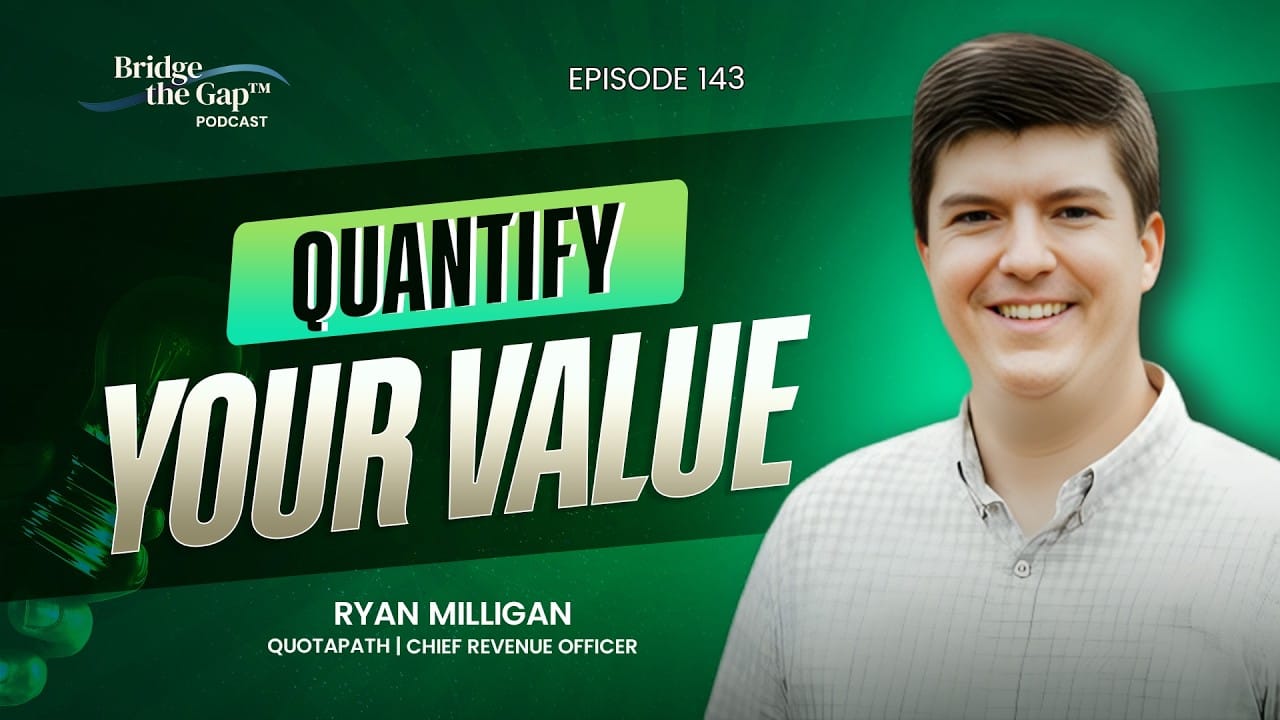
Are you losing deals because your sales team pitches vague promises instead of quantifiable ROI?
In this episode of Bridge the Gap, we sit down with Ryan Milligan, Chief Revenue Officer at QuotaPath, to discuss how to build scalable revenue systems that actually work.
We discuss how reps should be leading with quantitative ROI so buyers can easily justify the purchase to their CFOs.
Key Highlights
✓ Why "saving time" is the weakest B2B value prop and how to define exactly what "better" means
✓ How a single comp plan tweak increased multi-year deals from 15% to 75% in one quarter
✓ The disconnect between what a CFO values and what a sales rep actually gets paid for
✓ Why Customer Success Managers must be commercially measured to drive real value
✓ Why your software needs deep ecosystem partnerships to survive AI tools like Claude
✓ How to stop overcomplicating your Ideal Customer Profile and evaluate it correctly
If your sales team is struggling to get buyers to pull the trigger, this episode will teach you exactly how to anchor your pitch in undeniable data and build a revenue system that scales.
Agree? Disagree? Have Questions?
Leading a team with real talent but inconsistent results? Reply and we will work it with you.
Talk soon,
Adam, Dale, & Jake
Helping companies bridge the GTM Gap™.