I recently reviewed a B2B marketing budget where a company spent $68,000 on a single brand video. It generated massive engagement across social media… and ZERO closed-won deals.
That is the reality of modern marketing: attention does not automatically equal revenue.
This week, we will break down how the best revenue teams are moving beyond cosmetic marketing metrics and building high-converting campaigns that generate real enterprise pipelines and make selling infinitely easier.
Estimated reading time is 3.5 minutes. Hit reply and tell us what you are seeing on your side.
On Deck:
The Trap Of Aesthetic Marketing
Marketing Tip of the Week Powered by Decoded Strategies
Episode #136: Your GTM Foundations Are Probably Wrong | Vihaar Nandigala

The Trap Of Aesthetic Marketing
I sit in dozens of pipeline reviews every quarter, and the biggest waste of capital is always the brand awareness campaign. Teams obsess over clever taglines and beautiful color palettes, but when I look at the CRM, the math is brutal. Creative-led marketing is completely missing the modern buyer.
Here is why I see purely creative campaigns failing to drive REAL revenue today:
Selling the product instead of the problem
Most campaigns immediately pitch the software. But buyers do not care about your features until they feel understood. If your ad does not articulate their specific daily nightmare better than they can, they scroll past. You must agitate the REAL pain before you ever introduce the solution to the market.
Optimizing for applause over action
If your creative agency is bragging about impression share or video completion rates, fire them immediately. I have never seen a company hit its revenue targets using vanity metrics. A successful campaign is measured entirely by sales-qualified opportunities and closed-won revenue. Clicks and likes are a complete distraction.
The generic messaging trap
You cannot use the same messaging for the CFO and the end user. When campaigns try to speak to everyone, they resonate with absolutely no one. Effective campaigns require persona-specific messaging that speaks directly to the financial KPIs and operational priorities of the person actually controlling the budget.
Forgetting the core narrative
Campaigns fail when they try to be too clever. I see companies use abstract metaphors that confuse the prospect. If a buyer cannot figure out exactly what you do and how you save them money within three seconds of seeing the ad, your creative has completely failed its primary job.
Engineering The Conversion Event
There is a right way to capture attention and turn it into dollars. The campaigns that actually convert do not feel like advertising. They feel like highly specific consulting. You have to build a narrative that challenges the status quo and forces the prospect to rethink their operations.
This is the exact framework I use to build campaigns that generate a high-intent pipeline.
The polarizing point of view: Stop playing it safe. If your campaign message is something everyone in the industry already agrees with, it is useless. You must take a definitive stance against a common practice. Tell them exactly why their current approach is failing. Friction creates attention, and attention creates the initial sales discovery meeting.
The proprietary data wedge: Buyers are completely immune to generic ebooks. But I see massive conversion rates when companies publish original data. Survey your existing customers, aggregate the benchmarks, and show prospects exactly how they compare to their peers. You immediately position your company as the ultimate authority in the space, accelerating deep trust.
The hyper-targeted rollout: Run the ads only to their IP addresses, send direct mail to their executives, and have SDRs call simultaneously. Total saturation for a micro-audience always beats broad digital distribution.
The friction filter: Great campaign repels bad-fit prospects just as strongly as it attracts the right ones. Use highly technical language and specific use cases that only your true ideal customer profile will actually understand, appreciate, and deeply care about solving. When the wrong prospects bounce and the right ones lean in, you know the campaign is working.
Building Assets Buyers Actually Want
You cannot just ask a cold prospect to book a demo. That is way too much commitment. Before a buyer is willing to talk to sales, they need to see immediate value. The most effective campaigns create an intermediate step: an asset so useful that a prospect would normally expect to pay for it.
Here are the four types of campaign assets that generate the highest-quality leads:
The interactive diagnostic tool: Do not just tell them they have a problem. Make them prove it to themselves. Build a simple ROI calculator or a maturity assessment. When a buyer inputs their own numbers and sees the financial leakage in black and white, the urgency to buy your solution skyrockets instantly and naturally.
The unfiltered teardown: Take a common mistake you see in your industry and break it down step by step. Explain exactly why it fails and provide the specific framework to fix it. This immediately proves your expertise and gives the buyer a quick win before they even speak to a sales representative.
The executive blueprint: If you need to sell to the C-suite, stop writing for end users. Executives do not read 30-page whitepapers. Instead, build a one-page strategic blueprint that shows how your methodology directly impacts revenue, cost efficiency, or operational performance. A concise financial narrative is far more powerful than a long technical document..
The live tactical workshop: Traditional webinars are fading, but live working sessions are thriving. Invite a small group of prospects to a campaign event where you solve a problem live on the call. This creates genuine human connection and proves the immediate return on investment of your methodology without feeling like a software pitch.
The Post-Click Reality Check
The biggest lie in marketing is that the campaign ends when the prospect fills out the form. In reality, that’s where the real work begins. Even the best campaign will fail if the handoff between marketing and sales breaks down.
Here are the four areas to always audit to ensure a campaign actually converts into pipeline.
The five-minute rule: If a prospect downloads your high-value asset and an SDR takes a full day to reach out, the deal is dead. I mandate a five-minute response time on all high-intent campaign conversions.
Scripting the exact follow-up: Never let reps guess what to say next. If the campaign is about reducing churn, the follow-up email MUST reference that exact topic.
Tracking the dark funnel: Buyers will see your ad, ignore the link, and search for your brand on Google later. You will think organic search is driving revenue, but it was actually the campaign.
Ruthless pipeline post mortems: Do not wait until the end of the quarter to evaluate performance The best revenue teams treat campaigns like experiments: double down on what works and shut down what doesn’t - fast.
The Bottom Line
Great marketing campaigns do not just capture attention. They create deep trust and urgency. Stop optimizing for cheap clicks and start building assets that close REAL revenue.
Shoutout to Sendoso for Keeping This Newsletter Free!

We trust Sendoso for all our gifting needs. Why?
Thoughtful gifting fosters meaningful connections.
The best product catalog in the space & truly personalized gifting.
AI-powered personalized triggers enhance engagement throughout the sales process.
We’ve seen firsthand how effective gifting accelerates pipeline and retention. If you’re looking to win and retain more customers, book a demo with Sendoso, and we’ll personally send you a special gift, just reply and let us know you booked!
Check Them Out.
Marketing Tip of the Week - Powered by Decoded Strategies
Once a quarter, have sales, marketing, and CS show each other what they've built or learned. It forces alignment and cross-pollinates ideas.
Innovation happens in the overlap, not the silo.
Episode #136: Your GTM Foundations Are Probably Wrong | Vihaar Nandigala
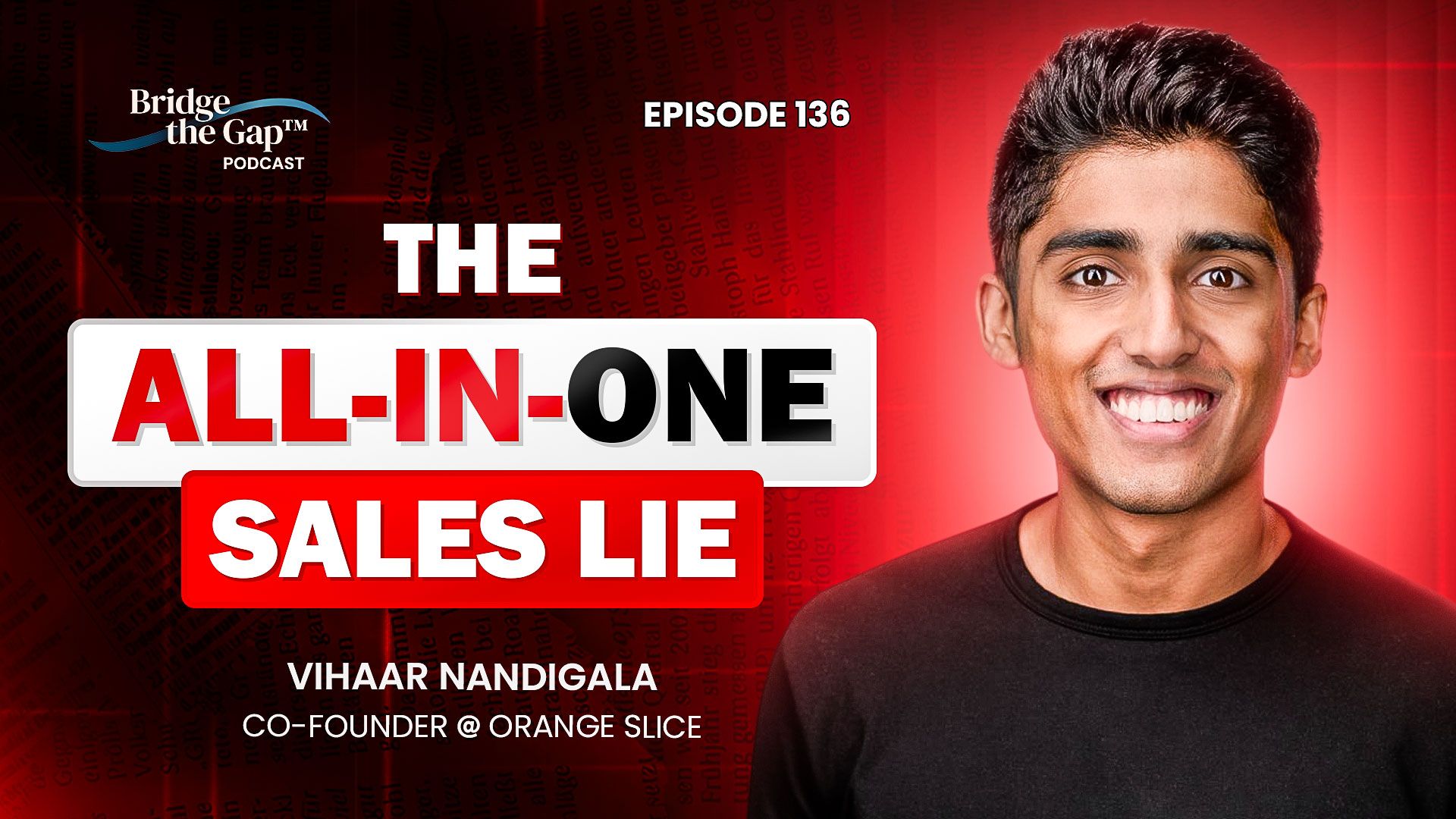
Is your sales team drowning in a bloated tech stack that does 27 things poorly?
In this episode of Bridge the Gap, we sit down with Vihaar Nandigala, Co-Founder of Orange Slice, to break down the "all-in-one" tech stack trap and why relying on bundled tools is killing your go-to-market efficiency.
Key Highlights
✓ The Tech Stack Trap: Why "all-in-one" tools do 27 things poorly
✓ Why you really only need 1-2 core pieces of sales infrastructure
✓ Using a raw database as a CRM instead of bloated legacy platforms
✓ The end of cold email (and the rise of "paid marketing" outbound)
✓ Why timing beats personalization every single time
✓ Moving from static data lists to live internet scraping
If you are a founder or revenue leader tired of bloated tech stacks and looking to build a high-signal GTM engine, this episode is for you.
Agree? Disagree? Have Questions?
Are your campaigns generating clicks but zero pipeline? Reply and we will work it with you.
Talk soon,
Adam, Dale, & Jake
Helping companies bridge the GTM Gap™.